©1999 Environmental News Network
In the atmosphere, nitrous oxide acts as a catalyst
in ozone
depletion. The
government
study shows
nitrous oxide emissions along the South Platte River in Colorado and
Nebraska, where the measurements
were taken, are comparable to some of the highest known emission rates in
the world.
Per molecule, nitrous oxide causes more destruction to the Earth's
protective layer than
chlorofluorocarbons, and it warms
the planet about 200 times as effectively as carbon dioxide.
The total annual nitrous oxide emissions from the South Platte River are
similar to the estimated annual
nitrous oxide emissions from all primary municipal wastewater treatment
processes in the United States,
according to the article.
"If this one river system is similar to others, then nitrous oxide
emissions from rivers could be a major
human-made source of N2O to the atmosphere," said U.S. Geological Survey
hydrologists Peter McMahon,
Ph.D., and Kevin Dennehy, who conducted the one-year study.
However, the researchers point out that measurements from other rivers are
needed before drawing any
final conclusions.
Few published accounts exist of nitrous oxide emissions from an inland
river, said McMahon and Dennehy.
Most nitrous oxide studies have focused on wastewater treatment plants,
agricultural fields, forests and
lakes, they said.
As with many rivers in the U.S., the South Platte receives wastewater
effluent from municipalities and
groundwater return flows from irrigated fields. The measurements were
taken along a 450-mile stretch of
the river from North Platte, Neb., to just above Denver, Colo.
The nitrous oxide being released by the Platte River is the same gas used
by the dentist as an
anaesthetic and by drag racers to increase the power of their engines. The
difference lies in the
concentration of the gas, said McMahon.
The federal study
was published in
the Jan. 1 issue of Environmental Science
and
Technology, a journal
published by the American Chemical Society.
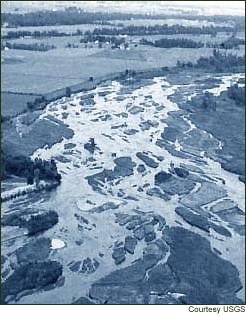 Rivers may be emitting
significant
amounts
of nitrous
oxide as a result of effluents
from wastewater
treatment plants and agricultural
fields, according to a study by the U.S. Geological Survey.
Rivers may be emitting
significant
amounts
of nitrous
oxide as a result of effluents
from wastewater
treatment plants and agricultural
fields, according to a study by the U.S. Geological Survey.